Direct Mail That Gets Opened: Formats, Lists, and EDDM
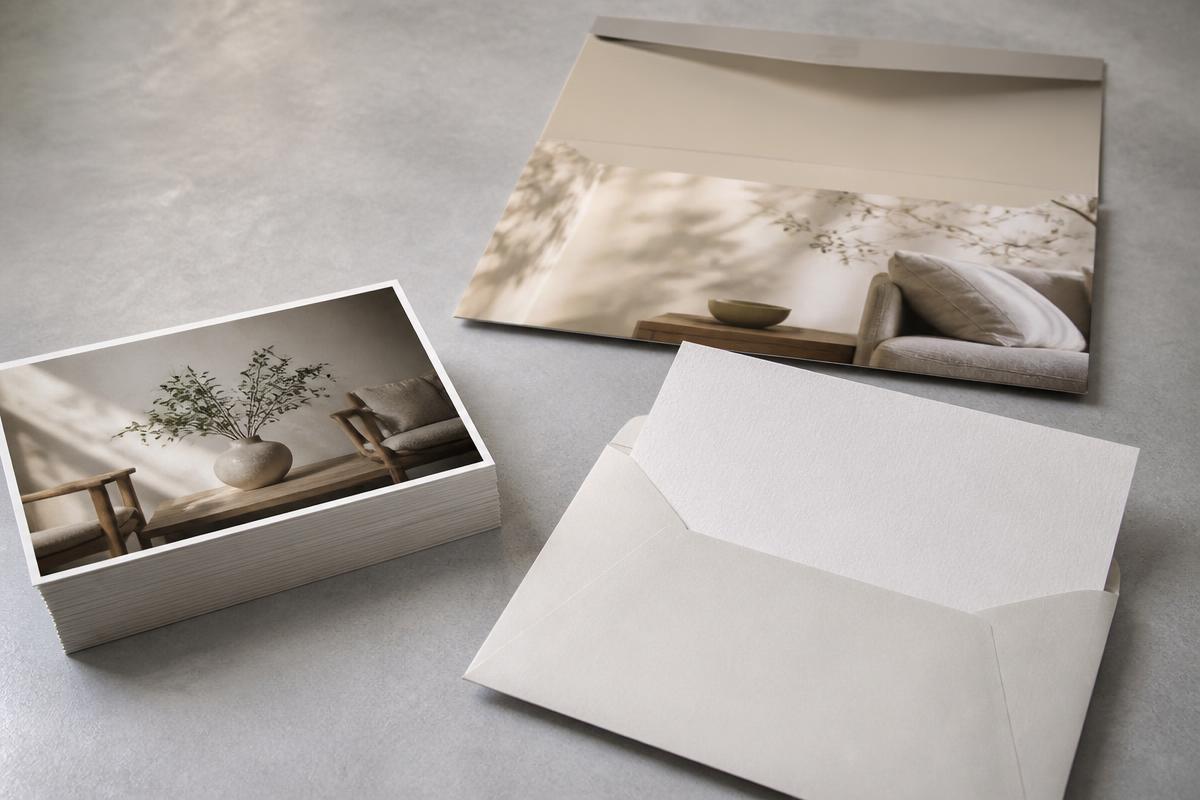
Direct mail still works because far fewer businesses use it than use email. A practical look at postcard formats, mailing list options, Every Door Direct Mail, and the design rules that keep postage affordable.
· 7 min read
By Jeni Wilkins, Nex-Jen Print
Direct mail's advantage is arithmetic. A person's inbox gets hundreds of messages a week; their mailbox gets a handful of real pieces. A well-built postcard doesn't compete with a spam folder, it competes with two utility bills and a grocery flyer.
Choosing a format
- Postcards: the workhorse. No envelope to open, so the message is seen whether or not anyone decides to engage. Cheapest to produce and to mail.
- Oversized postcards: more room and more physical presence in a stack, at higher postage. Often the best tradeoff for an offer that needs explaining.
- Folded self-mailers: a brochure that mails itself, tabbed shut. More content, still no envelope.
- Letters in envelopes: the right call when the message is personal, confidential, or long. Lower immediate visibility, higher perceived importance.
- Dimensional mail: anything lumpy. Expensive per piece and near-impossible to ignore; reserve it for a short list of high-value targets.
Every Door Direct Mail vs. a targeted list
EDDM is a USPS program that mails to every address on selected postal carrier routes without needing individual names or addresses. You pick neighborhoods on a map, print to specific size and marking requirements, bundle the pieces, and drop them at the post office. It's the least expensive way to blanket a geographic area and it fits businesses whose customers are simply whoever lives nearby, restaurants, home services, retail, clinics, seasonal offers.
A targeted mailing list is the opposite approach: fewer pieces, chosen by criteria that matter to you, business type, property ownership, household characteristics, past customers. It costs more per piece and usually returns more per piece, because you're not paying to reach people who will never buy.
The honest rule: if geography is your main filter, EDDM. If anything else is, use a list.
Your own customer list is the best list
Before buying anything, mail the people who have already paid you. Past customers respond at rates that rented lists rarely approach. Clean the addresses first, mailing to a stale list wastes postage on pieces nobody receives.
Design rules that also protect your postage
Postage rates depend on size, thickness, and shape, and the thresholds are specific. A card slightly over a size limit, or an unusual shape, can jump to a materially higher rate. Confirm the mailing specs before finalizing a layout, this is the most common expensive surprise in direct mail.
- Leave the required clear space for the address block, barcode, and indicia. Nothing may print in it.
- Lead with the offer, not your logo. The recipient decides in about two seconds.
- One offer and one action. A card asking for three things gets none of them.
- Give a reason to act now: a date, a limited quantity, a season.
- Make the response method large and obvious: phone number, short URL, or QR code.
- Print the offer on both sides. You don't control which side lands face up.
Frequency beats perfection
One mailing is a test, not a campaign. Response tends to build with repetition, and a modest card sent three times to the same audience usually outperforms one expensive piece sent once. Plan a sequence and budget for it before you print anything.
Measure it
Mail is measurable if you set it up to be. Use a dedicated phone number, a unique landing page or QR destination, or a code the customer mentions. Track how many pieces went out, how many people responded, and what those responses were worth, that's the number that tells you whether to mail again.
Common questions
- What is EDDM?
- Every Door Direct Mail is a USPS program that delivers to every address along selected postal carrier routes without a mailing list of names and addresses. It has its own size, marking, and bundling requirements, and it is generally the lowest-cost way to reach a defined geographic area.
- Is EDDM cheaper than a targeted mailing list?
- Per piece, usually yes, because there's no list cost and postage is reduced. A targeted list costs more per piece but reaches people selected by criteria that matter to your business, which often produces a better return when your customers aren't defined purely by location.
- What size should a direct mail postcard be?
- Postage tiers depend on exact dimensions and thickness, and EDDM has its own minimum size. Because being slightly over a threshold can raise the rate, confirm the mailing specification before the design is finalized.
- Does direct mail still work?
- It works in part because it is less crowded than digital channels, a mailbox holds a handful of pieces where an inbox holds hundreds. Results depend heavily on the list, the offer, and mailing more than once.
Thinking about a mail campaign?
Tell us who you want to reach and what you want them to do. We'll help you choose a format and mailing approach, and quote the printing.
Keep reading
Business Card Stock and Finishes, Explained in Plain English
14pt or 16pt? Gloss, matte, or soft touch? A guide to the paper weight, coating, and finishing choices that decide how your business card feels in someone's hand.
How to Send Print-Ready Artwork: Bleed, Resolution, and Color
Most print delays come from artwork, not printing. This is a plain-language guide to bleed, safe margins, resolution, CMYK color, fonts, and file formats, and what to do if all you have is a logo.